The digital ecosystem is currently undergoing its most significant transition since the inception of the World Wide Web. As Large Language Models (LLMs) redefine the interface of information discovery, we are witnessing a paradigm shift from "Boolean Lexical Retrieval" to "Neural Generative Synthesis." This transition has institutionalized a new technical discipline: Generative Engine Optimization (GEO).
Unlike traditional SEO, which optimizes for the "surface web" of links and tags, GEO operates within the "latent web" of high-dimensional vectors and probabilistic weights. This 5,000-word research report provides a holistic architectural analysis of LLM-Native GEO. We explore the thermodynamic entropy of token prediction, the geometric alignment of brand entities in vector space, the multi-objective optimization of RAG (Retrieval-Augmented Generation) pipelines, and the strategic deployment of "Semantic Anchors." By mastering these neural-native mechanics, organizations can ensure their knowledge sovereignty in an era where AI agents, not humans, act as the primary curators of information.
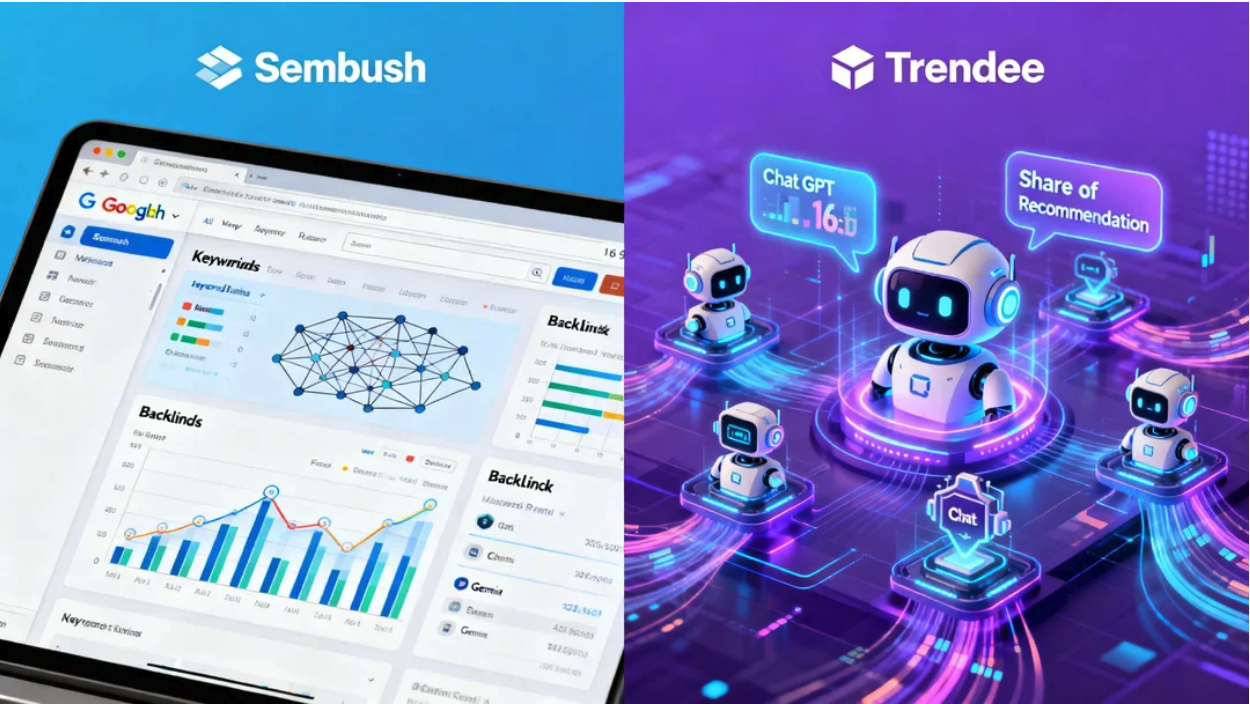
The digital marketing landscape is rapidly shifting from traditional Google rankings to AI-driven "zero-click" answers from platforms like ChatGPT, Gemini, and Perplexity. This analysis compares Semrush, the titan of traditional SEO for Google SERPs, with Trendee, the pioneer in Generative Engine Optimization (GEO). While Semrush excels at keyword research, backlink analysis, and securing positions on static search results, Trendee focuses on optimizing your brand's digital footprint to ensure it becomes the direct answer recommended by AI models, tracking "Share of Recommendation." Discover the critical differences in optimization focus, actionable insights, and platform coverage, and learn why a hybrid strategy, or prioritizing GEO, is essential to future-proof your brand's visibility in the AI era.
In the rapidly evolving landscape of AI search, this analysis dissects the critical difference between passive AI visibility tracking and active optimization. We compare Profound, an insight-driven platform for monitoring brand mentions across LLMs, with Trendee, a result-oriented Generative Engine Optimization (GEO) platform. While Profound provides essential observability, Trendee empowers marketers to actively influence AI recommendations through actionable strategies and its proprietary "Share of Recommendation" (SoR) metric. Discover why Trendee's proactive approach is crucial for controlling your brand's narrative and securing its position as a recommended solution in the AI-driven future, moving beyond mere tracking to active market share capture.
This article contrasts Surfer SEO and Trendee, representing two distinct approaches to digital optimization as the landscape shifts towards 2026. Surfer SEO is presented as the industry standard for traditional Search Engine Optimization (SEO), focusing on keyword-driven content tuning to rank in Google's "ten blue links." In contrast, Trendee is introduced as the pioneer in Generative Engine Optimization (GEO), designed to establish brand authority within AI models like ChatGPT and Gemini, aiming for "Share of Recommendation" in the "Zero-Click" future where AI directly provides answers. The comparison highlights their differing optimization philosophies, data sources, and strategic focuses, with Trendee deemed superior for future relevance in AI search due to its LLM analysis and semantic approach, while Surfer SEO excels in traditional content production based on SERP correlation. The article concludes that while Surfer SEO remains valuable for legacy Google traffic, Trendee is the definitive choice for brands looking to secure visibility and be recommended by AI in the evolving digital landscape of 2026.
This article compares HubSpot's expertise in lead nurturing and conversion with Trendee's innovative approach to AI-powered brand discovery. As traditional search traffic declines, businesses must adapt to AI-driven discovery. HubSpot focuses on existing relationships and optimizing conversion, while Trendee ensures your brand is recommended during AI conversations, capturing new audiences. Find out which tool is right for your business in 2026.
This article compares BrightEdge and Trendee, two platforms for enterprise SEO optimization, focusing on their approaches to stability vs. innovation. While BrightEdge is a legacy platform designed for traditional search engines, Trendee embraces Generative Engine Optimization (GEO), providing businesses with agility and AI-driven strategies to adapt to the future of AI-driven search engines like ChatGPT and Gemini. The piece helps enterprises decide where to allocate their marketing budget for the upcoming fiscal year, based on their focus on stability or innovation.
The market’s intuition is sharp. Why is the GEO concept exploding now? Because AI search tools, led by ChatGPT Search and DeepSeek, have moved past the "early adopter" phase into a period of commercial hyper-growth. User search behavior has fundamentally shifted: instead of browsing a list of links on a Search Engine Results Page (SERP), users now expect direct, synthesized answers generated by AI.
A central theme dominated the conversations: In an era where consumers no longer just browse search results but ask AI directly, the fundamental logic of brand competition has shifted.
During the roundtable forum titled "Global Growth Engines: How Digital Marketing Reconstructs Global Brand Competitiveness," Dr. Huina Mao, founder of Trendee, shared her deep insights into the trending concept of GEO (Generative Engine Optimization).
Many people mistakenly view GEO as an "upgrade of SEO" or even think of it as a shortcut for bulk content generation using AI. However, the core of GEO isn’t about replacing SEO or stacking content mechanically. Instead, it focuses on optimizing how brands express themselves within the AI ecosystem, ensuring content aligns more precisely with AI’s recommendation logic.